Building Ftesë.al, an invitations platform
Designing a product people use once, for an event that matters: personal guest links, an RSVP dashboard and clear packages.
Contents10
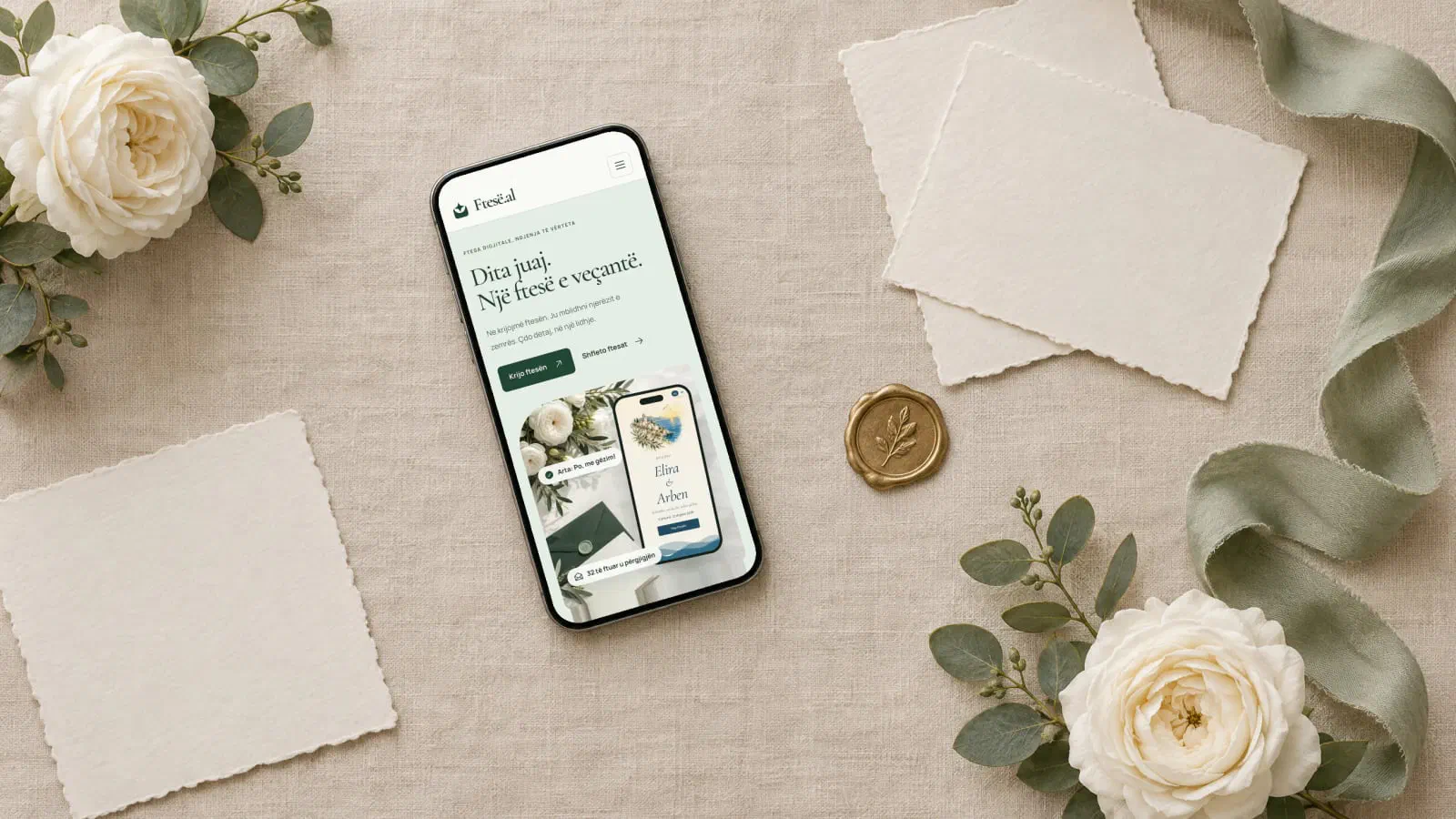
Ftesë.al is a platform for invitations designed by a studio, for weddings, birthdays and other celebrations. Each guest receives a personal link, hosts follow the replies in a dashboard, and invitations can be shared as a link or a QR code. We built it in 2026 with Next.js and React.
Most products are designed for people who come back every day. This one is designed for people who may use it once or twice in their life, for an event they care about a great deal. That changes many of the decisions, and this post is about those decisions.
A product people use once
A host planning a wedding does not want to learn software. They want the invitation to look right, reach the right people and tell them who is coming. Guests want even less: open the link, read the details, reply, and find the venue on the day.
That gave us two simple tests for every feature:
- can a host who has never used the platform understand it the first time?
- can a guest use it from a phone, without creating an account or installing anything?
If a feature failed either test, it changed or it waited. A product used once gets no second visit to teach the person how it works, so the first visit has to be enough.
Personal links instead of a public form
The obvious way to collect replies is a single form that anyone with the link can fill in. It is quick to set up, and it tends to cause the same problems: duplicate replies, names spelled in several ways, one person answering for a whole family, and no clear way to see who has not answered yet.
Ftesë.al gives each guest a personal link instead. The link already knows who the invitation is for, so the reply arrives attached to the right name. The host sees who has replied and who has not, without matching free text against a guest list.
Personal links also make privacy the default rather than a setting. The public site says it plainly: an invitation is private from the start, it is opened only by guests with their personal link, and invitations do not appear in search engines.
An RSVP dashboard for the host
On the other side of those links is a dashboard where the host follows replies in one place, instead of collecting them from messages, calls and conversations at family dinners. With the Standard and Premium packages, the host can also download the replies as a CSV file, which is useful when the numbers have to go to a venue, a caterer or whoever is drawing the seating plan.
A dashboard like this is usually checked a few times in the weeks before the event, often from a phone. The questions are short: how many people are coming, who has not answered, what did they write. As a general rule, the screen should answer those questions before it offers anything else.
Sharing where guests already are
Invitations are shared as a link or as a QR code. The link travels the way families already talk to each other: the public site suggests sending it over WhatsApp, a text message or email. A QR code suits anything printed, such as a card for relatives who prefer paper, or a sign at the venue.
Designing for a link that opens inside a messaging app has practical consequences:
- the first screen has to load quickly on mobile data
- the text has to read well on a small screen
- the reply has to be easy to find without scrolling through every section
Our article on why WhatsApp and Instagram are not a website makes a related point from the other direction. Messaging apps are where people talk, but the information itself works better on a page you control, with one link that always shows the latest version.
What the invitation carries
An invitation is more than a decorated card. On the day, guests need practical information, often in a hurry and sometimes while already driving. Ftesë.al invitations include:
- a map of the venue, so guests can find their way from the invitation itself
- a countdown to the event
- calendar links, so guests can add the date to their own calendar
Calendar links are a small feature, but for an event announced months in advance they do a useful job: the date moves from a chat thread, where it gets buried, to the calendar guests already check.
More than one language
Invitations are available in Albanian and English, and the public site lists Italian, German and French as further options. Basic and Standard invitations can use up to two languages, and Premium up to three in the same invitation.
The reason is general rather than specific to any one family. Many Albanian families have relatives who live abroad, and guests at the same event may read different languages comfortably. A second language on the same invitation means nobody receives a separate, translated copy that might fall out of date. We describe the wider version of this decision in Albanian and English websites.
Drawing the packages
Ftesë.al is offered in three packages: Basic, Standard and Premium. The public site describes them this way:
- Basic: one of the studio’s designs with the host’s own text, one cover photo, the sections for guests, studio help by email, and availability until 14 days after the event
- Standard: up to eight photos, an album where guests upload their own photos, a CSV export of replies and a link to a gift registry
- Premium: up to fifteen photos, up to three languages, the host’s own colours and design details, longer availability after the event and priority handling from the studio
The line between them follows one principle. Everything a guest needs to receive the invitation and reply to it is in every package: the personal link, the reply, the map, the countdown and the calendar link. A guest should not get a weaker invitation because of the package the host chose. The paid extras serve the host: more photos, more ways to work with the replies, more control over the design, more time online.
We prefer a few packages to a long price list for products like this, for reasons that apply well beyond invitations:
- someone buying a product once cannot judge twenty separate options, but they can compare three in a minute
- features that are used together are sold together, so the host does not have to work out which combination they need
- each step up has a reason a person can explain in one sentence
- the studio can plan its work, because each package describes a known amount of design and support
A price list with every feature as a separate line pushes that work onto the customer, at a moment when they already have a lot to organise.
Guest data deserves care
A reply list is personal data. It holds names, who is coming with whom and whatever guests write in their messages. The guests did not choose the platform, the host did, which puts more responsibility on the product to handle that data carefully.
For any product that collects information about people who never signed up for it, these are reasonable starting points:
- keep invitations private by default and out of search engines
- ask only what the host needs to know
- decide in advance when the data stops being available
- treat exports as copies that leave the platform
Ftesë.al handles the third point with an expiry date. The studio sets it, and if no date is set, the invitation expires automatically 14 days after the event. Premium invitations stay online longer, which is one of the reasons to choose that package.
CSV exports are convenient, and they are also a copy of the guest list on someone’s computer. A host who downloads one should treat it like any other list of contacts. For the wider basics, see our article on website security for small businesses.
What carries over to other products
Ftesë.al is about invitations, but most of what we learned applies to any product someone uses rarely and for something important:
- remove sign-up for the person on the receiving end
- design the first screen for a phone, opened from a chat
- decide what is private before deciding what can be shared
- group features into a few packages, each with a clear reason to choose it
- decide when the data is removed, and tell people
See it
You can see invitations at ftese.al and the project in our portfolio. If you are planning a platform with accounts and packages, our post on building a white-label SaaS platform covers more of the technical side. You can estimate a budget with the calculator or tell us about your product.