Kleo: a marketing site and an app, kept apart
Why the Kleo marketing site and its AI workspace are separate codebases, how visitors move between them and when one codebase is enough.
Contents7
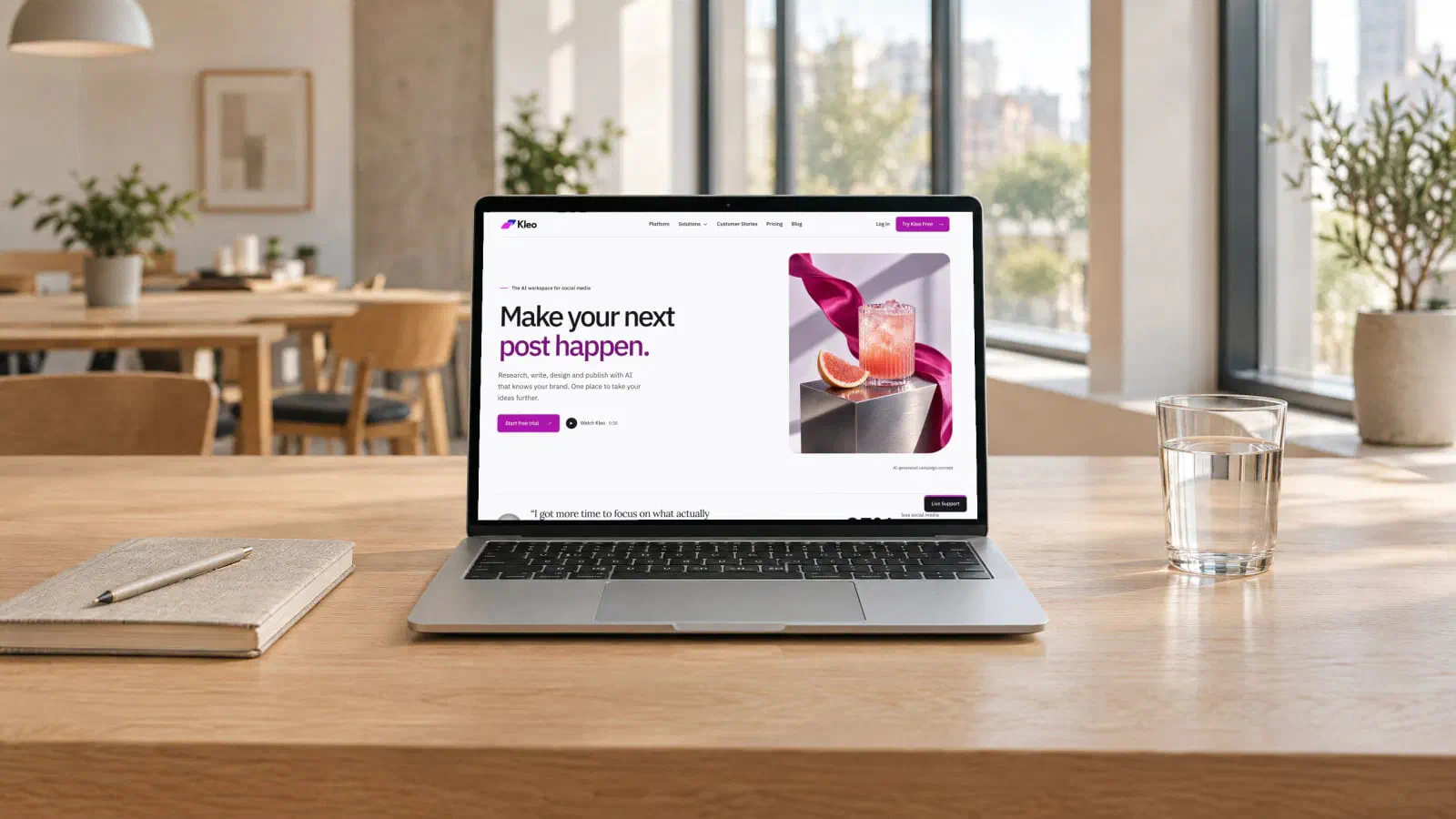
Kleo is an AI workspace for social media. The application at app.mykleo.ai brings research, writing, images, video and social publishing into one place. The marketing site at mykleo.ai explains the product and sends visitors into a free trial. We built both, and we built them as two separate projects.
This post explains why, how a visitor moves from one to the other, how the brand stays consistent across both, and when keeping everything in one codebase is the better choice.
The problem Kleo addresses
Marketing teams often move between separate tools for research, writing, design and publishing. Each tool has its own login, its own files and its own idea of what the brand looks like. Kleo needed two things to address that: the product platform itself, and a fast marketing site that explained the AI workspace clearly enough that visitors would want to try it.
The application is built with Next.js and organised around three areas:
- Signals for research: exploring web sources, links and documents to find an angle and develop a draft
- Studio for creating content: captions, images and video
- Calendar for scheduling posts across connected social accounts
The marketing site is built with Hugo and hosted on Cloudflare Pages. It introduces those three areas, offers a free trial and a demo, and has separate paths for agencies, businesses and creators.
Two products with different jobs
It is tempting to see the marketing site as the front door of the app and build them together. In practice they do different jobs for different people, and most of the reasons for separating them follow from that.
Different audiences
The marketing site is read by people who have not decided yet. They arrive from a search, an ad or a recommendation, and they want to understand what the product does, who it is for and what it costs. The application is used by people who have already signed up and want to get work done. One audience needs explanation and reassurance. The other needs speed and tools.
Different release rhythms
A marketing site changes when the message changes: a new landing page, a pricing update, a feature announcement, a customer story. An application changes when the product changes, and those releases go through testing, migrations and careful rollouts. Tying the two together means either the marketing team waits for an app release to fix a typo, or a copy change ships alongside code it has nothing to do with.
Performance and search
A marketing site has to load quickly for someone who has never visited before, on whatever device and connection they have, and it has to be readable by search engines. Hugo builds the site into plain HTML files ahead of time, and Cloudflare Pages serves them. There is no server rendering a page for each visitor and no application code to download before the text appears. Our article on why we use Hugo goes into this approach in more detail.
An application behind a sign-in has different priorities. It does not need to be indexed, and the people using it are already committed. It needs fast interactions once loaded, reliable data and a clear interface for complex work.
Who edits what
Marketing copy is usually edited by people who think about positioning, not by the engineers who maintain the application. When the marketing site is its own project, with content in simple files, changes to a headline or a pricing page do not touch the code that handles accounts and publishing. Reviews stay smaller, and a copy change is far less likely to break the product.
Security surface
The marketing site holds no accounts, no customer content and no connections to social media accounts. It is a set of static files. The application holds all of that, and it needs authentication, permissions and careful handling of data. Keeping them apart means the public, frequently edited site carries none of the application’s sensitive surface, and a mistake on a landing page is far less likely to put customer data at risk.
Independent uptime
If the application is being deployed, migrated or is having a problem, the marketing site still loads, so new visitors can still read about the product and existing users can still find the way to sign in. The opposite holds as well: a broken landing page does not stop anyone from working in the app.
The handoff from site to sign-up
Separation only works if the move from one to the other feels like one product. On mykleo.ai, the main calls to action are clear and consistent: “Start free trial” and “Try Kleo Free” both go to the sign-up page at app.mykleo.ai, “Log in” goes to the sign-in page there, and “Book a demo” opens a booking page for a walkthrough.
A few general practices make that handoff smoother in any setup like this:
- Keep the domain family. A marketing site at the main domain and the application at a subdomain, as with mykleo.ai and app.mykleo.ai, tells visitors they are still in the same place.
- Make the next step obvious. One primary action, repeated where it makes sense, usually works better than several competing buttons.
- Ask for little at sign-up. The trial is the moment of highest interest. Every extra field before the person sees the product is a reason to stop.
- Give existing users a short way in. A visible “Log in” link saves returning users from scrolling through a page written for newcomers.
- Offer a human route. Some buyers, especially agencies and larger teams, want to see the product with someone before they commit. A demo booking serves them without slowing down everyone else.
The separate paths for agencies, businesses and creators help here too. Each group arrives with different questions, and a page that speaks to their situation makes the trial feel relevant before they start it.
One brand across two codebases
The risk of two projects is that they drift apart: the marketing site gets a new colour, the application keeps the old one, and the product starts to feel like two companies.
What helps:
- Shared design decisions. Colours, type, spacing and the logo are defined once and used in both projects, whether by copying a small set of tokens or by publishing them as a shared package.
- The same names everywhere. Signals, Studio and Calendar are described on the marketing site with the same names they have in the application. A visitor who reads about Studio on the site should find Studio after signing up.
- Screens that match. Screenshots and product images on the marketing site need updating when the interface changes. It is easy to forget and easy to notice.
- One voice. The same tone in headlines, buttons, error messages and emails makes the transition feel natural.
What separation costs
Two codebases are not free, and it is worth being honest about the cost:
- two builds, two deployments and two sets of dependencies to keep up to date
- the header, footer and some components exist in two places
- the brand needs deliberate attention to stay consistent
- measuring the path from first visit to sign-up across two domains takes some planning
For a product like Kleo, where the marketing site speaks to first-time visitors and the application handles accounts, connected channels and generated content, we judged the benefits worth those costs. That is not true for every product.
When one codebase is enough
Keeping the marketing pages inside the application is a reasonable choice when:
- the product is early and the marketing site is a single page
- the same small team writes the copy and the code
- most of the product’s value is public content that needs indexing anyway, such as a directory or a catalogue
- the framework already renders public pages as static HTML, and you are disciplined about keeping them light
A single codebase can be split later. It is easier to separate a marketing site that was built with clear boundaries than to untangle one that shares everything with the application.
Questions to ask before you decide
- Who will edit the marketing site, and how often?
- How often does the application release, and what does a release involve?
- Does the marketing site need to be fast for first-time visitors on mobile?
- What would happen to sign-ups if the application went down for an hour?
- How will you keep colours, names and screenshots consistent?
You can see Kleo at mykleo.ai and the project in our portfolio. For more on building SaaS products, read how we built a white-label SaaS platform or one platform on the web, iPhone and Android. You can estimate a budget with the calculator or talk to us about your product.