Turning a research report into a website
How chapter links, citations, languages and audio make long research easier to read, share and cite.
Contents8
A good part of our work is long-form research: reports on censorship, guides for journalists, essays on protest design. We have built the web editions of the Apple Censorship report on Russia, Blocked by Numbers for the Open Technology Fund, Designing for Dissent by Professor Tyler Galloway and the SaferJourno guide for Internews.
Each one started as a large body of text. The work was to make it readable on a screen, easy to cite and possible to update.
A PDF is not always enough
A PDF is good for printing and archiving, and many organisations still need one. It is harder to read on a phone, harder to link to a specific section and harder to translate or correct after publication.
A web edition does not have to replace the PDF. It gives readers another way in: they can arrive from a search or a shared link, read one chapter, and leave with a link they can quote.
Give every chapter its own address
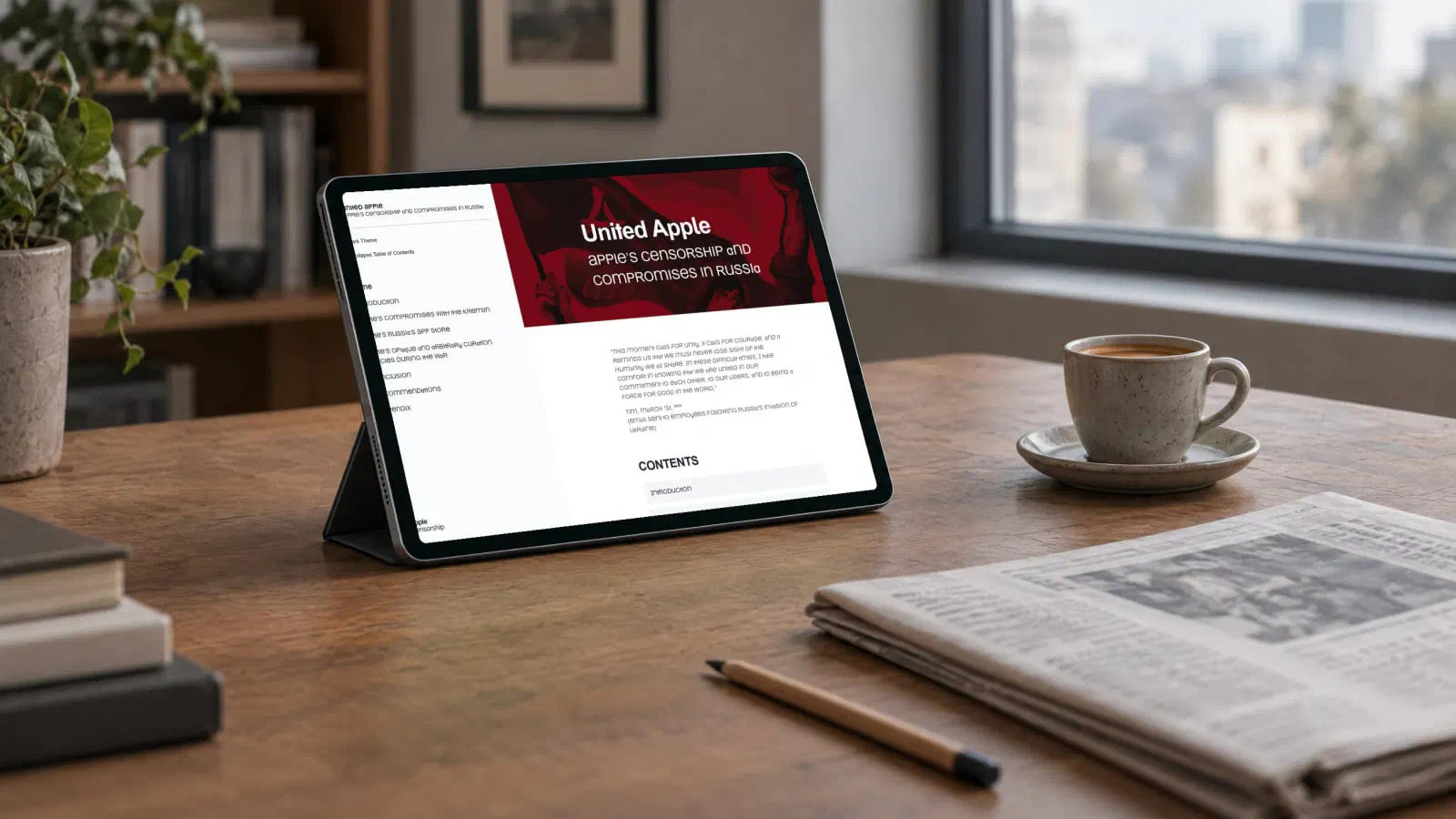
The Apple Censorship report is divided into chapters, each with its own URL. That small decision changes how a report travels. A journalist can link to the chapter on App Store policy instead of describing where to scroll. A researcher can cite a section precisely.
The report also has a table of contents, citations, recommendations and an appendix. Some readers go through it from start to finish. Others jump straight to the recommendations. The structure should support both.
Make navigation part of the reading
Long documents need a way to see where you are and what comes next. In practice that means:
- a table of contents that stays reachable while reading
- clear chapter titles that make sense on their own, because they also become page titles and link previews
- previous and next links at the end of each chapter
- search, when the report is long enough that readers look for a term rather than a chapter
Blocked by Numbers, a report on how real-name registration policies affect access to Chinese social media apps, combines chapters with search.
Treat translations as editions
Blocked by Numbers is published in English and Chinese. A second language is easier to support when it is planned from the start: each chapter exists in both languages, links point to the matching chapter rather than the homepage, and language switching keeps the reader in the same place.
SaferJourno, a digital safety guide for trainers and journalists, was rebuilt with Hugo with a structure meant to support additional language versions. Its eight chapters run from digital risk to the safe use of AI, with case studies and practical exercises.
Offer more than one way to read
Designing for Dissent brings more than a decade of material on protest design and the “Fight for $15” movement into one publication, organised in chapters by theme. It also includes an audio version for readers who prefer to listen to the full essay.
Audio, print styles and downloadable versions all serve the same goal: the research should reach people in the format they can use.
Keep the sources close
Research is only as useful as its sources. Citations should link to the original material where possible, sit near the claim they support and remain readable on small screens.
The same applies to campaigns built on research. On Dirty Data Centers, a campaign about the environmental impact of large data centres, the arguments link to their sources. Readers can then use a letter form to contact decision-makers. Censored Planet takes a different route: it brings research tools, publications and open datasets together for both technical and general readers.
Plan for updates
Reports get corrected, expanded and translated after launch. SaferJourno replaced a 2014 edition, and the new structure lets the editorial team update one chapter at a time. Showing a visible “last updated” date helps readers judge how current the material is.
Before you start
If you are preparing a report for the web, it helps to have:
- the final text split into chapters, with short titles
- a list of sources with links where they exist
- the languages you plan to publish, and who translates
- whether you also need a PDF, a print version or audio
Our portfolio includes these publications. If you have research that should be easier to read and cite, send us a message.